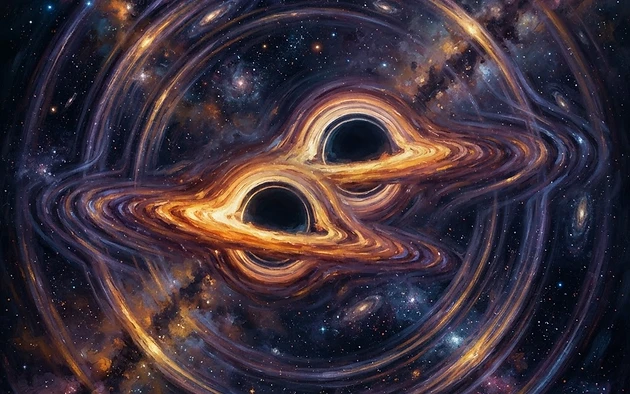
A Gravitational Crescendo: Cosmic Wave Catalog Expands Our View of Black Hole Collisions
Sunday 13 September 2026 · ~2 min read
Good morning, fellow inhabitants of spacetime. Grab your morning beverage of choice, ideally one that obeys standard fluid mechanics, because the cosmos has been delightfully noisy of late.
Astronomers processing data from the Laser Interferometer Gravitational-wave Observatory (LIGO) and its international collaborators have unveiled a dramatic surge in detected gravitational wave events, cataloging an astonishing array of violent cosmic collisions. For those unfamiliar, gravitational waves are essentially ripples in the very fabric of Einstein’s spacetime, produced when staggeringly massive objects—such as pairs of colliding black holes or neutron stars—whirl around one another in an ever-tightening orbital tango before finally slamming together.
Catching these signals is an engineering feat bordering on the preposterous. The detectors register spatial distortions smaller than a fraction of the diameter of a proton. When we began this enterprise less than a decade ago, catching even a single chirp from across the dark expanse was reason enough to break out the good champagne. Now, researchers are logging dozens of new mergers, giving astrophysicists a rich statistical sample rather than isolated curiosities.
What makes this growing census so thrilling is that it offers an unfiltered peek behind the cosmic curtain. Black holes are, by their very nature, completely dark to conventional optical telescopes; they do not politely emit visible light for our viewing pleasure. Gravitational wave astronomy allows us to 'hear' the universe instead of merely watching it, mapping black hole populations, calculating their masses, and testing whether general relativity holds up under the most brutally intense gravitational fields in existence.
Why this matters: We are shifting from an era of merely confirming that gravitational waves exist to performing high-precision cosmic archaeology. Each newly cataloged merger reveals how binary star systems live, die, and warp the universe around them, inching us ever closer to understanding how the macro-machinery of reality actually fits together.