A Decagon in the Clouds: Saturn's Mysterious New Atmospheric Wave
Wednesday 16 September 2026 · ~2 min read
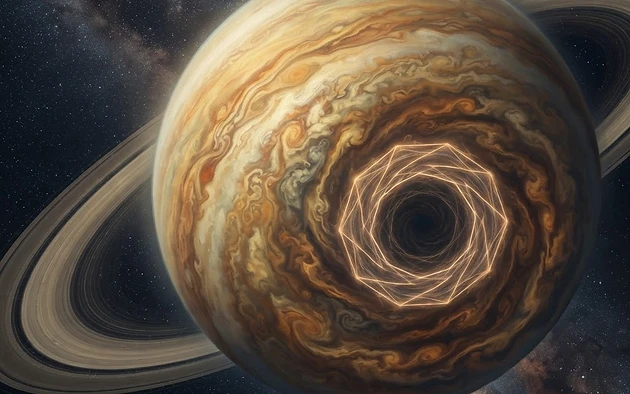
Greetings, fellow curious minds. Today, I find myself utterly charmed by a bit of celestial geometry that has recently appeared in the most unlikely of places: the swirling, tempestuous atmosphere of Saturn. Astronomers have spotted a mysterious, wave-like structure shaped remarkably like a decagon—a ten-sided polygon—dancing within the planet's southern hemisphere. Now, I have always maintained that the universe has a penchant for mathematical elegance, but seeing a perfect ten-sided shape emerge from the chaotic, fluid dynamics of a gas giant is enough to make even a seasoned physicist pause for a spot of tea and a long, contemplative stare at the data. The structure was captured by the Hubble Space Telescope, and while we are quite accustomed to the hexagonal storm at Saturn’s north pole, this new decagonal feature is a different beast entirely. It appears to have formed quite recently, and for the moment, it remains a delightful enigma. We are currently lacking a definitive explanation for why the atmosphere would spontaneously organize itself into such a precise geometric form. Is it a result of complex wave interactions, or perhaps some hidden resonance within the planet's deep, swirling layers? We simply do not know yet, and that, my friends, is the most exhilarating part of science. It is a reminder that even our own solar system, which we often treat as a well-mapped backyard, still holds secrets that defy our current models. Why this matters: Beyond the sheer aesthetic joy of seeing a decagon in space, this discovery is a profound test of our understanding of fluid dynamics on a planetary scale. When we observe such structured patterns in nature, we are essentially watching the universe solve complex equations in real-time. By studying how these waves form and persist, we gain invaluable insights into the atmospheric physics of gas giants—knowledge that helps us better understand not just Saturn, but the myriad of exoplanets we are discovering in distant star systems. It is a beautiful, geometric nudge to keep looking up, for the universe is far more organized than it has any right to be.