Galileo Goes Quantum: Free-Falling Atoms in Orbit Put Gravity to the Ultimate Test
Tuesday 8 September 2026 · ~2 min read
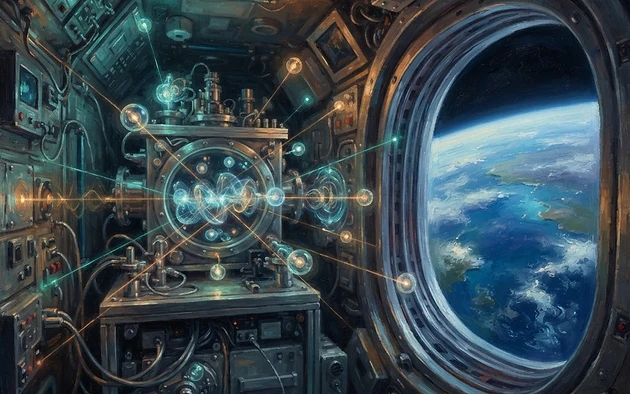
Good morning, curious minds. Picture the Leaning Tower of Pisa, circa 1589. Legend has it Galileo dropped cannonballs of differing weights off the parapet to show they would hit the cobbled street below in unison. Whether he actually did it or merely fancied the thought experiment over a glass of Tuscan red, the principle stuck: the Equivalence Principle, which dictates that gravity tugs on all mass identically. Now, physicists have transported Galileo’s dropping routine to low Earth orbit—swapping heavy cannonballs for ultra-cold, free-falling atoms aboard a spaceborne laboratory.
In standard everyday mechanics, general relativity reigns supreme. Everything falls together because gravity is merely curved spacetime. But drop down to the quantum scale—where particles exist in probabilistic hazes and like to behave as waves—and relativity begins to sweat. To test whether the Equivalence Principle holds up under microscopic scrutiny, scientists cooled clouds of different atomic species near absolute zero in space. In this microgravity sanctuary, unperturbed by the rumble of passing lorries or seismic shifts, the atoms were let loose to free-fall while laser interferometry tracked their descent with breathtaking precision.
And what did nature have to say? True to form, the quantum particles accelerated at precisely the same rate, confirming Einstein’s foundational principle down to extraordinary sensitivity. As fond as we physicists are of watching our reigning theories break—because that is usually where the Nobel prizes and the revolution hide—there is a deep, quiet elegance in seeing Einstein’s spacetime withstand yet another severe trial.
Why this matters: Bridging quantum mechanics and gravity remains the single grandest unsolved puzzle in physics. By taking atomic interferometers into the pristine quiet of space, we are forging measuring tools capable of spotting the tiniest fissures in reality's framework—clues that could finally deliver a unified Theory of Everything.