
A Whisper from the Cosmic Shadows: LZ Detector Glimpses Tantalizing Hints of Dark Matter
Wednesday 9 September 2026 · ~2 min read
Good morning, curious minds. Put the kettle on, because the universe's grandest game of hide-and-seek might have just taken a thrilling turn.
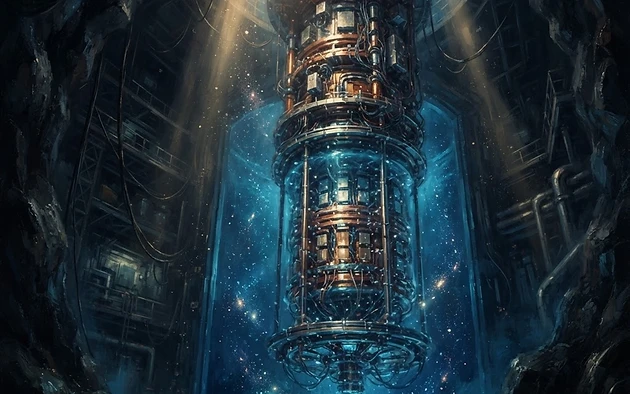
Deep beneath the Black Hills of South Dakota, inside an abandoned gold mine shielded by nearly a mile of solid rock, sits the LUX-ZEPLIN (LZ) experiment. It is essentially a magnificent, ultra-sensitive vat holding ten metric tonnes of liquid xenon, chilled to crisp perfection and waiting for the rarest tap on the shoulder: an elusive Weakly Interacting Massive Particle, or WIMP.
For decades, dark matter has made up roughly 85 percent of all matter in the cosmos, gracefully shaping galaxies while remaining utterly invisible and frustratingly aloof to our particle detectors. Enter LZ. In newly reported results from this titan of physics, researchers have teased something extraordinary—a faint, tantalizing whisper in the data that could signify the very first direct hints of dark matter interactions.
Now, as a physicist at heart, I must urge proper British composure before we rewrite the textbooks. Particle physicists operate under rigorous statistical standards, and a 'hint' is not yet a five-sigma discovery. It could conceivably be an exotic radioactive fluke or stray electronic noise mimicking an invisible interloper. But LZ was purpose-built to eliminate almost every conceivable whisper of background interference, creating one of the quietest radio-pure spaces on Earth. Seeing even a subtle ripple here makes the pulse quicken noticeably.
If confirmed, this wouldn't merely confirm that WIMPs exist—it would fling open the doors to physics beyond the Standard Model. It would bridge astronomical observations of warped starlight with the subatomic mechanics that hold the cosmos together. For now, the team is gathering more runtime, tuning their algorithms, and squinting into the quiet darkness.
Why this matters: We understand what five percent of the cosmos is made of—stars, teacups, galaxies, and ourselves. The remaining ninety-five percent is dark matter and dark energy. Unravelling even a single thread of dark matter's true identity would solve one of the greatest cosmological mysteries since humans first looked up at the night sky.