A Cocktail from the Cosmos: Interstellar Comet 3I/ATLAS Is Positively Dripping with Methanol
Thursday 10 September 2026 · ~2 min read
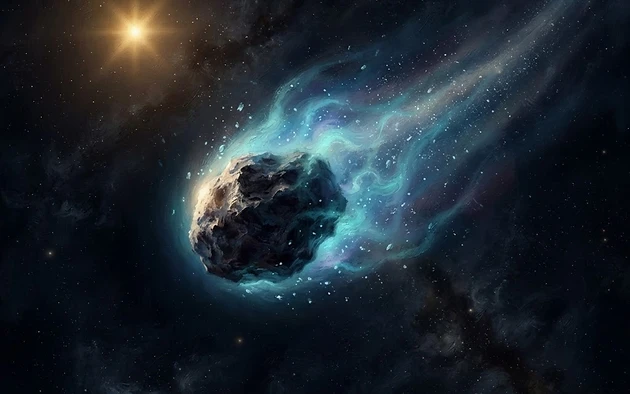
Good morning, curious minds. Put down your tea for a moment, because the universe has just coughed up an extraordinary delivery from across the galactic fence, and it turns out to be soaked in spirits.\n\nAstronomers pointing the Atacama Large Millimeter/submillimeter Array (ALMA) in Chile at our latest interstellar visitor, comet 3I/ATLAS, have managed to take its chemical fingerprint as it swung past our sun. What they discovered is delightfully eccentric: this cosmic vagabond is packing an absurdly high abundance of methanol—simple organic alcohol—dwarfing almost anything we have ever catalogued in our own solar system's native comets.\n\nBy tuning ALMA's radio antennas to the faint submillimeter emissions of outgassing molecules, the international team compared the comet’s methanol levels against hydrogen cyanide, a typical cometary staple. In solar system natives, that ratio is modest and well-behaved. In 3I/ATLAS, the methanol-to-cyanide ratio skyrocketed to between 70 and 120. Even more enchanting, ALMA revealed that as the comet’s nucleus heats up, tiny ejected grains of ice travel outward into its glowing shroud, vaporising individually like an escort fleet of pocket-sized mini-comets, each puffing out their own blue halos of alcohol vapour.\n\nWhy does this matter? Well, comets are essentially deep-freeze time capsules. The chemistry locked inside them preserves the raw, messy recipe of the protoplanetary disc from which they were forged. Because 3I/ATLAS was tossed out of another star’s backyard billions of years ago, peering into its coma gives us our first direct chemical sniff of how planets and pre-biotic ingredients are cooked around an alien star.\n\nThe astonishing surplus of methanol suggests 3I/ATLAS was born in an environment vastly colder and fundamentally different from the cradle that birthed our Earth and Jupiter. It is living—or rather, tumbling—proof that nature’s planetary recipe book has wild variations across the Milky Way.\n\nWhy this matters: We no longer have to build interstellar probes taking millennia to sample material from another star system. The cosmos occasionally tosses a fresh, pristine sample straight through our front parlour—giving astrobiologists an unprecedented peek into the prebiotic ingredients scattered across foreign worlds.