Hotter Than Lava, Solid as a Rock: Physicists Forge 'Superionic Ice' at Over 2,000 °C
Friday 11 September 2026 · ~2 min read
Good morning, inquisitive minds. Albert here, nursing an exceptionally hot cup of Earl Grey that pales in comparison to today's cosmic curiosity.
Water is, quite frankly, an eccentric little molecule. Chill it, and it floats; boil it, and it powers locomotives. But subject it to pressures millions of times greater than our atmosphere alongside infernal temperatures exceeding 2,000 °C, and water completely abandons its everyday manners. In an extraordinary laboratory feat reported by ScienceAlert, physicists have succeeded in creating a bizarre, glowing state of matter known as superionic ice at temperatures that would comfortably vaporise a gold watch.
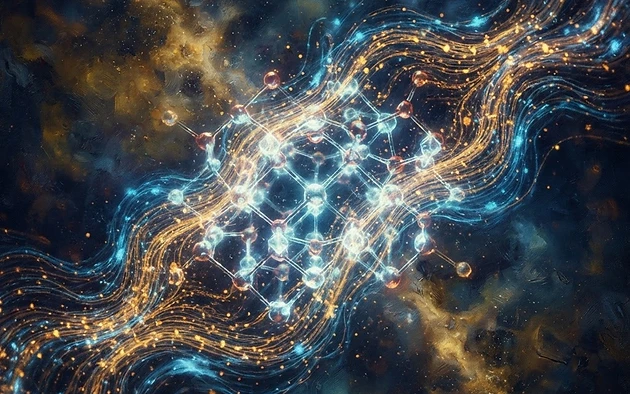
To manufacture this thermodynamic paradox, researchers bombarded microscopic droplets of water with petawatt-class lasers and diamond-anvil presses, compressing them into shockwaves that mimic the crushing interiors of giant planets. What emerges is neither traditional solid nor liquid. The oxygen atoms freeze into a rigid, crystal lattice, effectively forming a solid cage. Meanwhile, the hydrogen nuclei—mere protons—break free and flow freely through the lattice channels like a charged river.
Imagine a solid house where the brick framework remains steadfast while the plumbing casually detaches itself and wanders from room to room. Because these unmoored protons roam without restriction, this super-hot ice conducts electricity as readily as metallic copper, glowing white-hot while remaining structurally solid under immense pressure.
For decades, this hybrid phase was largely a matter of pen-and-paper equations and speculative simulations. Capturing it in real time—even for mere nanoseconds—proves that nature’s phase diagrams are far richer and weirder than standard textbooks dare suggest.
Why this matters: Beyond delightfully breaking our everyday intuition about melting points, superionic ice is suspected to be the dominant form of water across our galaxy. Worlds like Uranus and Neptune likely harbour immense superionic mantles. Understanding this strange state explains how these ice giants produce their lopsided, tangled magnetic fields—and gives us a tantalising roadmap for interpreting the exoplanets orbiting distant suns.