Diamonds Are Forever, and Now They Are Electric
Friday 18 September 2026 · ~2 min read
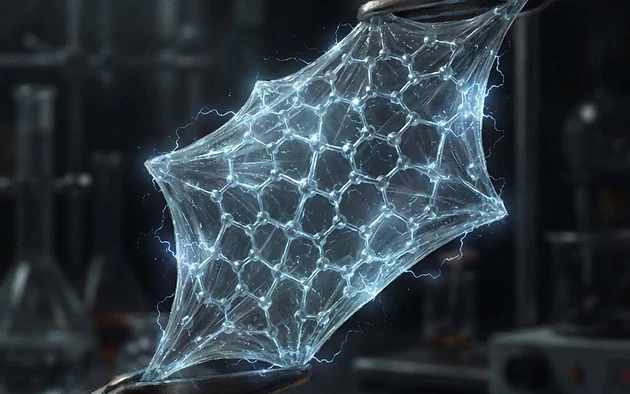
Hello, my fellow curious minds. Today, I have a rather sparkling bit of news that has tickled my physics-loving fancy. For years, we have held a rather rigid view of diamonds—those carbon-lattice wonders that are as stubborn as they are beautiful. We have long assumed that diamonds were incapable of producing electricity through mechanical deformation. It turns out, we were wrong. Researchers have recently discovered that ultrathin, flexible diamond membranes exhibit a strong and repeatable piezoelectric effect. Now, for those who haven't spent their morning pondering the intricacies of crystal structures, the piezoelectric effect is that delightful phenomenon where a material generates an electric charge in response to applied mechanical stress. Think of it as the material 'squeezing' out a bit of voltage when you give it a nudge. While we have seen this in other materials, seeing it in diamond—a material known for its extreme hardness and stability—is quite the revelation. By thinning these diamonds down to the nanoscale, scientists have managed to coax them into a flexible state, unlocking properties that were previously thought to be impossible. Why does this matter? Well, beyond the sheer joy of proving a long-held assumption wrong, this opens up a treasure trove of technological possibilities. Because diamond is incredibly robust, biocompatible, and resistant to harsh environments, these flexible membranes could lead to a new generation of high-performance sensors, advanced medical implants, or even ultra-efficient energy-harvesting devices that can operate in conditions where other materials would simply crumble. It is a brilliant reminder that even the most 'settled' science can be turned on its head with a bit of ingenuity and a very sharp scalpel. We are essentially teaching an old, hard-headed rock new tricks, and I, for one, cannot wait to see where this leads. Keep looking up, and perhaps keep an eye on your jewellery box—it might be more energetic than you think.